Novel Blade System for Top-Down SLA 3D Printing
- Relevant Skills: SolidWorks, Mechanical Design, 3D Printing, FEA, Experimental Design, Data Analysis, Technical Documentation
Background
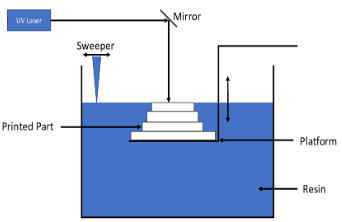
In Spring 2024, as part of MSE 127: Introduction to Additive Manufacturing, my project partner and I developed a stirring blade system for top-down SLA 3D printers. A persistent issue in stereolithography: resin contamination, settling, and viscosity changes due to UV exposure and debris. These problems reduce print resolution, shorten resin lifetime, and often require costly replacement. Our project aimed to address these challenges by designing, fabricating, and testing a novel blade mechanism for resin mixing.
Goals
The project objectives were to:- Design and fabricate a mechanical blade system to maintain uniform resin viscosity
- Prevent resin settling, minimize air bubbles, and reduce contamination
- Extend resin usability lifetime and minimize wastage
- Improve overall print quality and dimensional accuracy in top-down SLA systems
- Ensure the system was cost-effective, modular, and compatible with existing SLA printers
Design and Execution
- Design and Modeling:
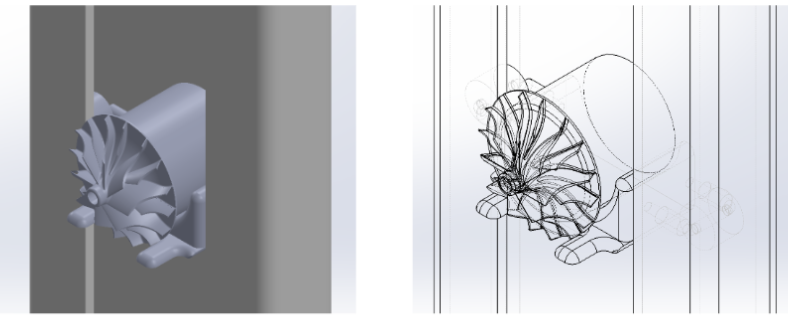
- Created CAD models in SolidWorks of an impeller-style blade optimized for radial and axial fluid flow
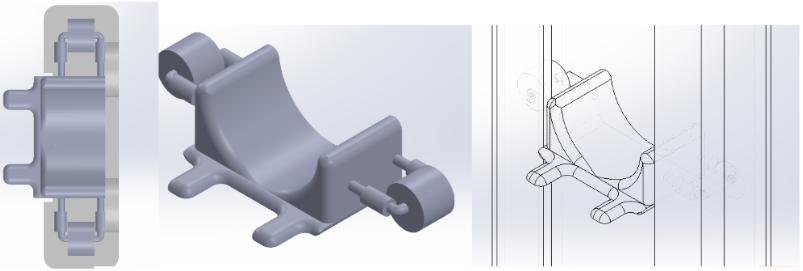
- Incorporated a motor housing and vertical rail system to allow stirrer height adjustment
- Used filleted edges to minimize stress concentrations and improve manufacturability with FDM 3D printing
- Simulation and Fabrication:
- Conducted FEA to validate structural durability under load and identify weak points
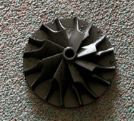
- Fabricated components with PLA using a Bambu P1S FDM printer
- Iterated on blade geometry after testing larger prototypes for flow efficiency and bubble minimization
- Experimental Testing:
- Designed a water–food coloring test setup to simulate resin mixing
- Measured time for different “viscosity levels” (1, 4, 10 drops of food coloring) to return to a uniform state
- Average mixing times: ~4 s (1 drop), ~41 s (4 drops), ~55 s (10 drops)
- Observed increasing trends consistent with viscosity-resistance to mixing, validating blade effectiveness
- Collaboration and Documentation:
- Maintained detailed CAD files, experimental logs, and analysis graphs
- Prepared a final report and presentation, including recommendations for filtration and ultrasonic alternatives
Outcome
The project delivered a functional stirring system prototype that:- Effectively homogenized simulated resins of varying viscosities.
- Validated impeller geometry for efficient radial–axial flow mixing.
- Demonstrated cost-effective fabrication via FDM 3D printing.
- Provided proof-of-concept data linking higher viscosity with longer mixing times, confirming system viability.
Image Gallery (Click to zoom):
Downloads: